La Semaine du Neuf 2026: Festival Guide
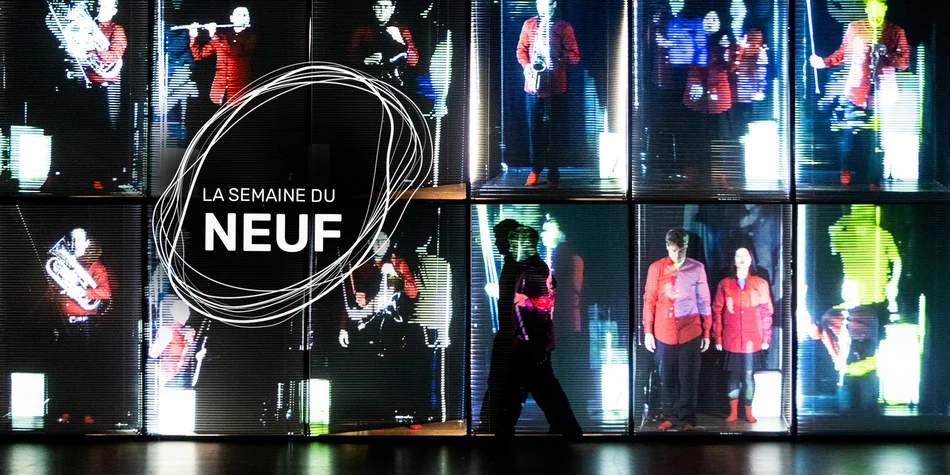
From February 27 to March 15, 2026, La Semaine du Neuf transforms Montréal into a playground for new music. Contemporary music, dance, hybrid performances, digital art, and sound installations: the festival celebrates the intersections of artistic imaginaries.
Not sure where to start? Here’s a guide to help you choose your events.
For Dance Lovers
These performances explore the body as instrument, with choreographed concerts where the stage becomes a space of exploration and dialogue between dancers and musicians.
Holding Present, a collaboration between choreographer Ula Sickle and the Brussels-based ensemble Ictus, where music and dance merge into a powerful collective gesture.
Le Souffle des Corps, a music-choreographic creation emerging from a residency by the saxophone quartet Quasar with the Escuela Superior de Música y Danza de Monterrey.
Protest Of The Physical by the collective lovemusic presents a performance in which the performer’s body becomes the very engine of sound creation.
For Tech & Digital Art Geeks
Motion sensors, interactive systems, spatialized sound, immersive projections: these works reinvent traditional scenography.
Corporate Retreat by Quigital, Architek Percussion, and soprano Sarah Albu: a theatrical percussion-centered performance enhanced by technology, inviting audiences to imagine the future of work.
Hearing Ice by Megumi Masaki: a narrative work for piano and multimedia raising awareness about climate change.
Le Murmure du Vivant by Alexandra Templier: a performance blending electroacoustic music, voice, dance, and visual art.
Broken Spaces by Ensemble Éclat: an immersive concert combining electronic music and digital visuals, developed in collaboration with IRCAM.
Speak no Words. Le silence des mots by Stick & Bow, Paramirabo & LiSiLoG: an exploration of gesture, sound, and light through an innovative technological setup.
For Contemporary Music Enthusiasts
La Semaine du Neuf is a must for discovering the richness of new music: world premieres, works by avant-garde composers, and thematic programs exploring texture, rhythm, and new forms of musical writing.
Hide to Show: The multidisciplinary performance by Belgian ensemble Nadar Ensemble questions our relationship to hyperreality.
Définir l’espace: A meeting between the McGill Contemporary Music Ensemble and the Swiss ensemble Ensemble Contrechamps.
Kino-Sonique, a triptych exploring hacked technologies and digital avatars with Ensemble Contrechamps & Architek Percussion.
Mouvements, a dialogue between electronics and instrumental immediacy by the French ensemble Proxima Centauri.
For Experimental Adventurers
Free improvisation, invented instruments, hybrid lutherie, unclassifiable interdisciplinary performances… Love surprises? These concerts are for you:
A double bill featuring Du Vivant, with its wild handmade instruments, alongside the collective formed by Sarah Bild, Susanna Hood, and the duo Nous perçons les oreilles, promises a thrilling encounter between improvisation and embodied expression.
Another double program highlights the improvisation group Limules alongside No Hay Banda and Colombian artist Ana María Romano.
Reflecting on Indigenous Curatorial and Creative Practices
At the heart of the festival, a symposium on Indigenous curatorial and creative practices in new music creates a vital space for dialogue and knowledge-sharing.
sqʷeq̓íp st’elti’telem (songs for gathering people): This two-day symposium explores how Indigenous forms of gathering, listening, and creating can transform the ways we conceive contemporary music.
sxelxéles te tl'etl'áxel (designs for inviting): A multidisciplinary performance created by Dylan Robinson in collaboration with artists from dance, film, and music.
For a Family Outing
On March 8, the festival presents Mini Neuf, a full day of musical discovery.
Playful performances combining object theatre, mime, and live music, as well as sound installations.
Workshops where children can explore music, build instruments, dance with Agora de la danse, and discover percussion.
Tips for an Eco-Friendly Festival
Choose public transportation! All venues are easily accessible by metro or bus:
Édifice Wilder – 1435 De Bleury Street
Metro: Place-des-Arts (elevator access) / Bus 80 Parc
CIRMMT – 527 Sherbrooke Street West
Metro: McGill / Bus 24 Sherbrooke
La Chapelle Scènes Contemporaines – 3700 Saint-Dominique Street
Metro: Sherbrooke / Bus 55 Saint-Laurent or 24 Sherbrooke
Espace Ste-Hilda – 6341 De Lorimier Avenue
Metro: Beaubien / Bus 18 Beaubien or 10 De Lorimier
Conservatoire de musique de Montréal – 4750 Henri-Julien Avenue
Metro: Mont-Royal
La Sala Rossa – 4848 Saint-Laurent Boulevard
Metro: Laurier
Bring your reusable water bottle — all venues have water fountains.
No need to print your tickets: simply show them on your phone!